

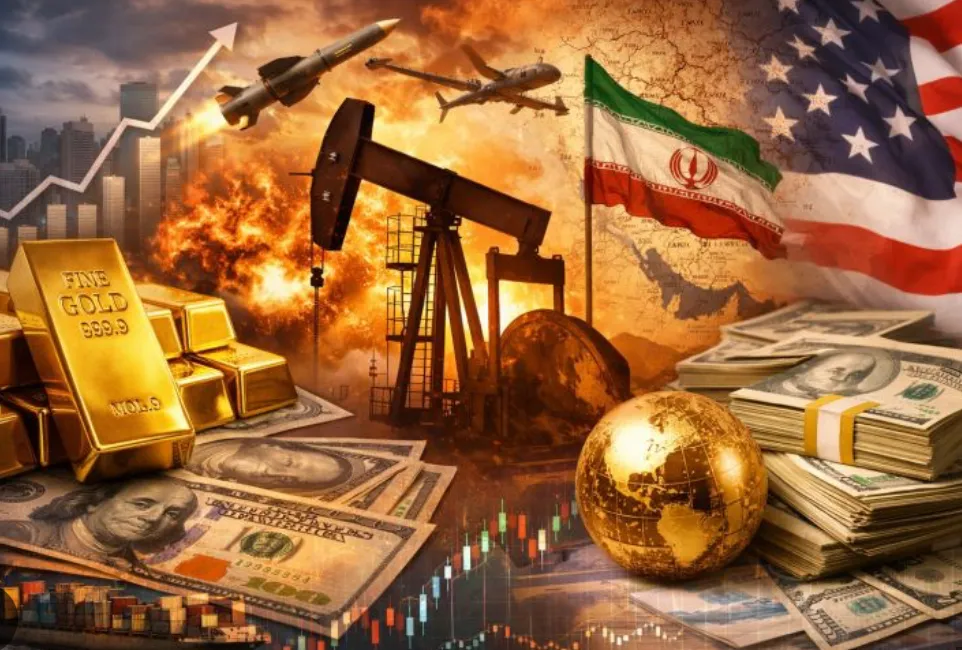
Today, roughly 60 percent of global foreign exchange reserves are held in dollars, and about 80 percent of global trade finance is conducted in dollars. The United States carries more than $30 trillion in public debt, yet it can borrow more easily and cheaply than most countries. This is because the world needs dollars to buy oil, to trade internationally, and to stabilize national currencies. To get and hold dollars, countries buy U.S. government bonds. That steady global demand allows Washington to keep borrowing even as deficits grow. When the U.S. prints or spends dollars, many of them flow abroad and are reinvested back into American markets. In simple terms, the global energy system helps finance American power. This is the core advantage of the petrodollar system.
Currency as Command: Sanctions and Sea Lanes
Reserve currency status does not simply enhance American influence—it institutionalizes it. Because the dollar is embedded at the center of global trade, finance, and reserves, the United States sits at the commanding heights of the international monetary system. Governments accumulate dollars not as a gesture of trust, but as a necessity for survival in global markets. This permanent demand gives Washington extraordinary fiscal latitude: it can issue debt at scale, run structural deficits, and expand its balance sheet without the immediate panic that would devastate other states facing similar ratios of debt to GDP.
This monetary position translates directly into strategic endurance. With borrowing costs suppressed by global demand for Treasuries, the United States sustains defence spending that exceeds that of the next several powers combined. It maintains hundreds of bases abroad, deploys fleets across oceans, and funds long-duration operations without triggering currency collapse. The dollar acts as both shield and engine—shielding the U.S. from sudden capital flight while fueling its global military footprint.
Yet the dollar is not only a source of strength; it is a lever of coercion. Because most cross-border payments clear through dollar-denominated systems, Washington can isolate adversaries from the financial bloodstream of the world economy. Sanctions become an economic siege. Assets are frozen, transactions blocked, revenues cut off. Iran’s oil exports have been sharply reduced through such measures. Entire economies can be pressured without a single troop crossing a border. Financial exclusion becomes a tool of strategic discipline.
All of this rests on geography as much as on finance. The Strait of Hormuz, Bab el-Mandeb, and the Suez Canal are the narrow gates through which global energy flows. If those chokepoints are disrupted, oil prices spike and markets convulse. American naval dominance in these waters ensures continuity of supply and reinforces the dollar’s central role in energy trade. Control the sea lanes, and you secure the oil flows. Secure the oil flows, and you secure the currency that prices them. The monetary system and the military system reinforce one another in a continuous cycle of power.
Iran and the Threat of Breaking Free
Iran is not just another country in the Middle East. It sits on vast oil and gas reserves and controls the coastline along the Strait of Hormuz—one of the most important energy routes in the world. That geography gives Iran real leverage. For decades, the United States has used sanctions to limit Iran’s economic growth and prevent it from turning its energy wealth into independent global influence.
But Iran has been trying to change that. In 2024, it joined BRICS, a group of countries openly discussing ways to trade outside the dollar system. China, the world’s largest oil buyer, has increased the use of its own currency in some energy deals. Russia, under heavy Western sanctions, has also shifted parts of its trade away from dollars. These moves are gradual, but their meaning is clear: reduce reliance on a financial system controlled by Washington.
If major oil producers and buyers begin trading energy in other currencies, global demand for dollars would slowly decline. That would mean fewer countries holding large dollar reserves and fewer governments buying U.S. Treasury bonds. Over time, this could raise American borrowing costs and limit Washington’s ability to finance massive military budgets through cheap debt. If borrowing becomes more expensive, sustaining hundreds of overseas bases and long-term military deployments becomes harder. In other words, weakening the petrodollar weakens the financial foundation that supports America’s global military reach—including its grip over the Middle East.
This is why the stakes are so high. The issue is not only Iran’s missiles or its nuclear program. It is whether a major energy power can sell oil in ways that bypass the dollar and encourage others to follow. If that happens at scale, the petrodollar system slowly erodes. As it erodes, America’s ability to spend freely on its military and enforce its will through sanctions also weakens. The conflict with Iran, therefore, is about more than territory or ideology—it is about preserving a financial order that underpins American global dominance.