


What this Article is About
This article begins with the story of a grandfather and his young granddaughter killed in Gaza, showing the deep personal loss felt by families caught in ongoing violence. It describes how watching repeated suffering from afar leaves many feeling guilt and helpless, as protests and posts barely change what is happening. The piece says global power structures and major states supply arms and support that keep the violence going. It argues that systems meant to protect humanity instead help sustain injustice. Finally, it suggests a return to principles of justice, mercy, and shared humanity as the only way to break the cycle of powerlessness and real suffering.
Yesterday, Khaled Nabhan, a man of quiet dignity and boundless love, was killed in an Israeli attack on Al-Nuseirat refugee camp, returning to Allah ﷻ. Khaled was a grandfather, a storyteller, and the gentle backbone of his family. The world came to know him through viral images on social media, where he cradled his lifeless 3-year-old granddaughter, Reem. “Soul of my soul,” he whispered over her still body – words that echoed the depth of his grief and love. Reem’s innocent life was stolen by the same merciless violence that has now claimed Khaled, leaving behind silence where their bond once shone.
This is Gaza – a place where families are torn apart not once, but again and again, where grief is endless, and mercy feels scarce. Khaled and Reem’s story is not unique, though it should be. In Gaza, grandparents bury their grandchildren, fathers search for sons beneath crumbling ruins, and mothers hold what remains of their children as the world watches in muted silence.
The Agony of Bearing Witness
There’s no escape from it. You wake up, check your phone, and it’s there – again. The nightmare unfolding in Gaza. Every day, the numbers grow: children buried under buildings, hospitals bombed, neighbourhoods flattened into dust. And you? You watch it all happen from the comfort of your screen, drowning in a helpless guilt you can’t shake. It clings to you, wraps itself around your mind like chains. You scream, you post, you march – but nothing changes. The bombs keep falling, and the world keeps turning.
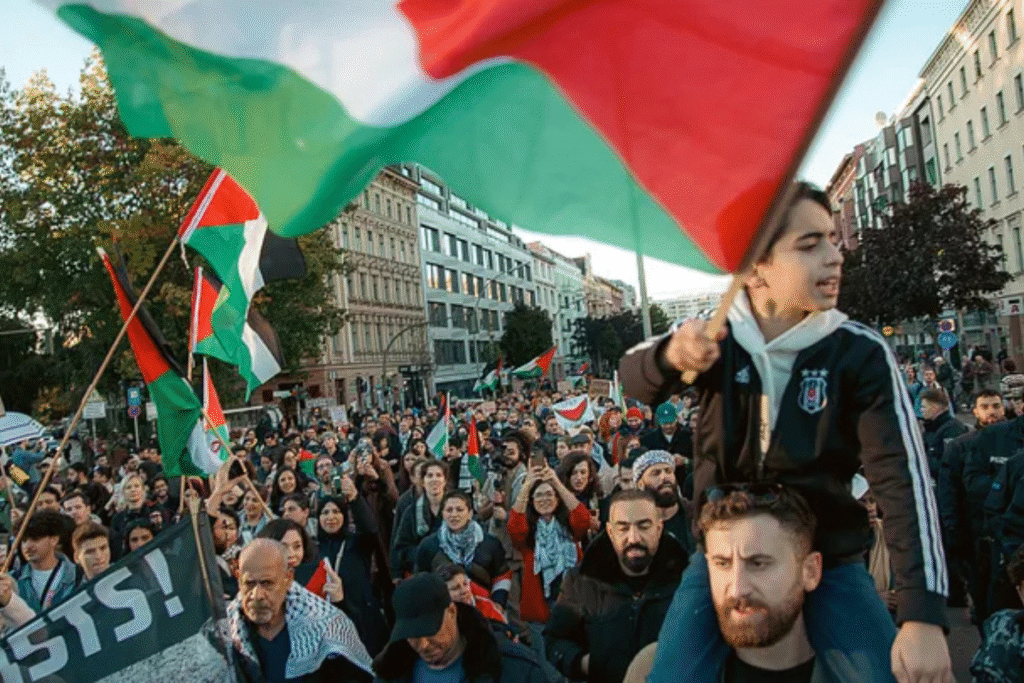
It’s a slow-motion drowning. You surface for breath, only to be dragged back under by the next breaking news update. The genocide grinds on, and you wake up every day to its bloody persistence. This isn’t just the guilt of witnessing suffering; it’s the soul-scorching weight of knowing you are powerless to stop it. Protests, petitions, and social media campaigns – they are the tools we are told to use, but deep down, you know they’re not enough. Necessary, yes. But hardly sufficient. You march in the streets, shouting slogans, but the bombs don’t hear you. And the ones dropping them? They stopped listening long ago.
The System Is Built on Injustice
The ugly truth is that the system itself fuels this carnage. Global powers, with their weapons and money, ensure that the suffering in Gaza – and elsewhere – never ends. The United States sends billions in military aid to Israel, Europe supplies arms and political cover, and the United Nations remains a powerless spectator. These institutions, meant to protect humanity, betray it instead. The system is not broken – it is working exactly as designed. It was built to concentrate power in the hands of the few and perpetuate injustice for the many.
The Only Alternative: The System of Islam
There is, however, an alternative to this oppressive order – a system rooted in justice, compassion, and divine guidance: the System of Islam. It is only by returning to the rules of Allah ﷻ, the Merciful Creator, that humanity can escape the destruction caused by incomplete and biased systems. Unlike human-made laws, which are riddled with self-interest and exploitation, the laws of Allah ﷻ are complete, just, and universal.
Allah ﷻ reminds us in the Qur’an:
The Prophet Muhammad ﷺ established a state rooted in justice, where the weak and the strong were equal before the law, and oppression had no place. He ﷺ said:
In an Islamic system, the oppressed would find protection, and the strong would be held accountable. Leaders would not serve themselves but serve the people, implementing the divine laws that forbid the spilling of innocent blood.
Allah ﷻ commands:
Justice in Islam is not a slogan; it is a command from the Creator of all humanity. It is the only system capable of delivering peace, dignity, and security to all, regardless of race, religion, or status.
A Scar on Our Collective Conscience
Gaza is a scar on the world’s conscience, a reminder of what happens when unchecked power is allowed to rule. The guilt we feel – the helplessness, the despair – is not just a burden but a call to act. But that action cannot come through the same broken systems that sustain this violence. It must come through the re-establishment of a divine system that puts justice and mercy at its core.
The Prophet Muhammad ﷺ said:
This is the justice of Islam – unwavering, impartial, and rooted in accountability.
We cannot simply bear witness to the world’s atrocities and hope for change from those who thrive on war and suffering. The system itself must be dismantled and replaced with one that honours life, justice, and dignity as commanded by Allah ﷻ. Anything less will perpetuate the cycles of oppression we see today.