

What this Article is About
This article starts by describing an unprecedented strike on Doha that broke long‑standing norms by targeting a delegation during negotiations and suggests this was not a chance event. It argues the attack shows how a certain foreign policy faction inside the U.S. system influences strategy beyond elected leadership and has shaped long‑term military and intelligence decisions in the Middle East. The text links this influence to doctrines that positioned certain states at the center of policy and promoted sustained regional instability rather than genuine peace. It says the result is policies that favour power projection and fragmentation over unity and justice. The piece frames these events as part of a deeper ideological and institutional pattern within global politics.
Introduction: An Unprecedented Strike on Doha
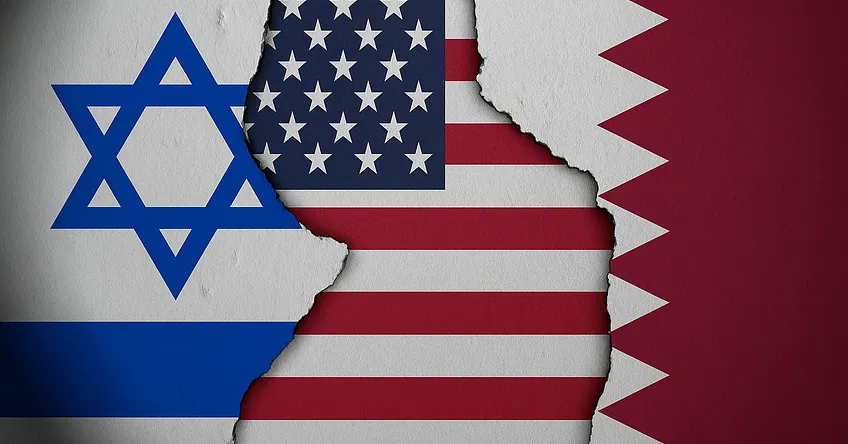
It began with silence in the skies over Doha – then came the strike that rewrote the rules. Israeli F-35s, firing from beyond Qatari airspace, targeted a Hamas delegation at the very moment negotiations were on the table. Overhead, a British RAF Voyager – officially present for a routine exercise – circled methodically, feeding real-time intelligence. The coordination was too exact to be dismissed as chance.
Qatar’s air defences stayed silent, bypassed with ease, leaving Doha exposed. This was no ordinary strike but a geopolitical rupture: Israel hitting on the soil of a U.S. ally, under the watch of a NATO partner, in a deliberate bid to extinguish American diplomacy. And yet, the shadow over the operation was darker still. U.S. Central Command, headquartered in Qatar, must have known and almost certainly given approval. Its commander had only recently visited Israel. That such an operation unfolded without the president’s knowledge points to a fracture at the very heart of American command.
Trump’s denial only magnified the shock. For allies and adversaries alike, the message was unmistakable: the rules of engagement had been broken, and Washington’s command over the region had slipped. This was a strike from the US deep state. In order to understand the dynamics of how the neoconservative ideology hijacked a Superpower’s military empire by embedding itself into the deep state, we need to review its origins and evolution.
Neoconservatism and the Quiet Capture of American Strategy
Few ideological movements in modern American history have exercised influence so far beyond their numbers as neoconservatism. Emerging in the late twentieth century from a small circle of intellectuals, the movement not only shaped the ideological terrain of U.S. foreign policy but also embedded itself in the institutions, networks, and bureaucracies that define Washington’s strategic reflexes. By the time of the September 11 attacks, neoconservatives had already built the intellectual architecture for a new grand strategy. All that remained was a catalyst, and 9/11 provided it.
From that moment onward, neoconservatism became more than a school of thought. It became what critics rightly call a foreign policy deep state: a durable, institutionalized framework that dictated policy options, trained personnel, and provided the moral vocabulary of American power. Its most enduring achievement was to transform Israel from an ally into the axis of U.S. Middle East policy. Rather than being imposed by external force, this centrality emerged from a coherent ideology, deeply embedded in the U.S. establishment, that viewed Israel as the perfect vessel for its own principles: moral clarity, democratic exceptionalism, strategic utility, and civilizational symbolism.
Many prominent neoconservatives are Jewish, including Irving Kristol, born in Brooklyn to Jewish immigrant parents, and Paul Wolfowitz, born to a Polish-Jewish family; this heritage undoubtedly influenced their favourable view of Israel, but this heritage was only one among several factors. There are also many connections to the British foreign policy establishment and the global financial headquarters in the City of London.
PNAC & Israel as the Strategic Axis – Objectives, Evidence, and Significance
The Project for the New American Century (PNAC), founded in 1997 by William Kristol and Robert Kagan, laid out a strategy of American primacy: strengthening democratic allies, challenging hostile regimes, projecting military force, and preserving an international order aligned with U.S. interests. Its Statement of Principles insisted that the United States must “strengthen our ties to democratic allies and to challenge regimes hostile to our interests and values,” while promoting “political and economic freedom abroad.” This doctrine set the stage for viewing Israel not just as an ally but as a central axis in a geopolitical framework premised on fragmentation, conflict, and managed instability.
A Clean Break: A New Strategy for Securing the Realm (1996), drafted for then-Prime Minister Benjamin Netanyahu by Richard Perle, Douglas Feith, David Wurmser, and others, pushed this further. It explicitly urged that Israel abandon conciliatory peace frameworks in favour of assertive strength, recommending cooperation with Turkey and Jordan to “contain, destabilize, and roll back some of its most dangerous threats.” Intelligence, military readiness, proxy warfare, and preemptive posturing were all part of this strategy.
Jonathan Cook’s Israel and the Clash of Civilizations: Iraq, Iran and the Plan to Remake the Middle East (2008) is especially seminal in analyzing how these doctrines played out in practice. Cook argues that the chaos that followed the Iraq invasion was not merely a mistake but “a calculated goal of the neocons and Israel alike.” He states that neither America nor Israel “wants strong, Middle Eastern democracies, or stable Arab countries, as their own continued dominance relies on the instability of others.”
Thus, Israel’s strategic role under neocon doctrine is multifaceted: preventing unity among Arab and Muslim states; acting as an intelligence and operational outpost; projecting military and covert capability; and helping sustain a regional order in which no rival can consolidate sufficient power. These sources show that Israel’s axis role was built into neocon doctrine – not as a subordinate controller, but as a center of leverage in a geopolitical architecture designed to fragment opposition, generate instability among rival states, provide intelligence, and allow U.S. influence to be projected through an allied, strategically placed power.