

9/11, Doctrine in Action & the Seven-Country Vision – Why Neocon Ideas Gained Traction
After the September 11 attacks, the United States was plunged into a period of shock, fear, and urgency. The existing foreign policy orthodoxy-containment, diplomacy, cautious multilateralism-was widely perceived as having failed, or at least to have proved insufficient. Traditional realist approaches seemed powerless in the face of a diffuse global jihadist threat. In the vacuum of uncertainty, neoconservative ideology offered moral clarity, the sense of decisive action, defence against an existential threat, and a promise that future attacks could be prevented by proactive strategy rather than a reactive policy.
Appeasement lost moral and political capital. Many Americans, still reeling from the attacks, were willing to accept more aggressive foreign policy instruments: preemption, democracy promotion, and regime change. Key political figures and think tanks who had long argued for confronting rogue states found their warnings suddenly plausible. The “War on Terror” rhetoric absorbed many of these pillars: safe havens, rogue states, military preemption, and the transformation of authoritarian regimes.
A vivid example of how bold the neocon agenda became is captured in retired General Wesley Clark’s 2003 account of a Pentagon memo. In Salon, Clark claimed that shortly after 9/11, a senior military officer showed him a memo from the Secretary of Defence’s office:
This plan, whether fully operationalized or not, became emblematic of neocon ambition. It signified a shift: from deterrence and diplomacy to grand reordering. When status quo policies seemed passive or complicit, neocon ideas offered a bold alternative-removing entire regimes, reshaping regions, and eliminating perceived sanctuaries for extremism.
Embedding Power: How the Deep State Becomes Unshakeable
Neocon doctrine succeeded not merely by its moral or intellectual arguments but by embedding itself into institutions. Think tanks such as PNAC, AEI, Hudson Institute, the Washington Institute, and others continuously produced strategic designs aligned with neocon thinking. Their alumni populated key government positions across successive administrations, ensuring that even if a president rhetorically opposed interventionism, many of the personnel of the apparatus remained committed to it.
Media narratives reinforced threat-based framing and moral clarity. Opposition voices were often marginalized or labeled soft on terror. Congress, pro-Israel lobbies, evangelical networks, and strategic interest groups established political costs for departing from support for Israel. Military aid lines, arms sales, intelligence sharing, diplomatic cover-all accrued institutional inertia: once commitments are made, reversing them becomes exponentially difficult.
The Deep State Endures in 2025: Resistance & Reinforcement
Donald Trump began his second term in 2025 under the promise of reducing U.S. foreign entanglements, ending so-called “endless wars,” and placing a greater priority on domestic needs. Many in his base, particularly among young voters, independents, and morally concerned Democrats, hoped this would translate into a realignment in U.S. policy in Gaza, including the use of aid as leverage to restrain Israeli operations.
However, the deep structure built by neocons limits how far Trump can depart from the axis. One strong piece of evidence: former Arkansas Governor Mike Huckabee was confirmed by the Senate on April 9, 2025, by a 53-46 vote as U.S. Ambassador to Israel, a position of high symbolic and operational significance. Mike Huckabee’s confirmation is a powerful indicator of how strongly the neocon-axis remains entrenched. Beyond its symbolic weight, it matters because of his publicly stated views. In a June 10, 2025, interview with Bloomberg, Huckabee said he does not believe an independent Palestinian state remains a U.S. foreign policy goal, adding: “Unless there are some significant things that happen that change the culture, there’s no room for it … those probably won’t happen in our lifetime.” He also used the biblical term “Judea and Samaria” rather than “West Bank,” signalling alignment with hardline Israeli settlement narratives.
Because ambassadors are central to diplomacy, policy framing, intelligence sharing, and strategic messaging, appointing someone with such clear alignment drastically narrows the room for any administration, even one with anti-neocon or war-weary rhetoric, to depart from the Israel-axis framework. The confirmation, along with his statements, embeds the axis more deeply into the structure of U.S. foreign policy, reinforcing the notion that policy commitments will persist regardless of political change.
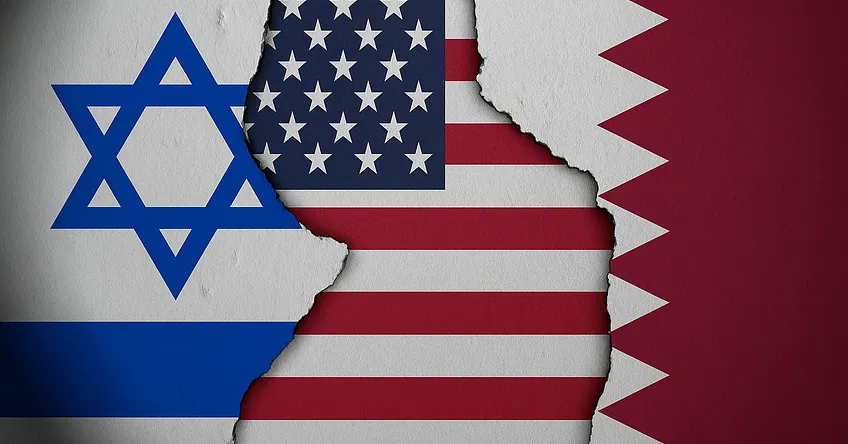
Also, the recent Qatar bombing – Israeli airstrikes in Doha targeting Hamas leaders – illustrates how Israel-central policy can override norms of sovereignty. Trump described himself as “very unhappy” with the strike, especially given that it occurred in a U.S. ally’s territory and risked undermining U.S.-mediated ceasefire efforts.
Public polling reveals growing disapproval of Israeli military actions: some polls show around 32% approval among U.S. adults for Israel’s operations in Gaza, whereas large majorities disapprove; among Democrats, approval may drop into single digits. Yet amid this discontent, policies (diplomatic cover, aid, intelligence cooperation) continue largely unchanged.