

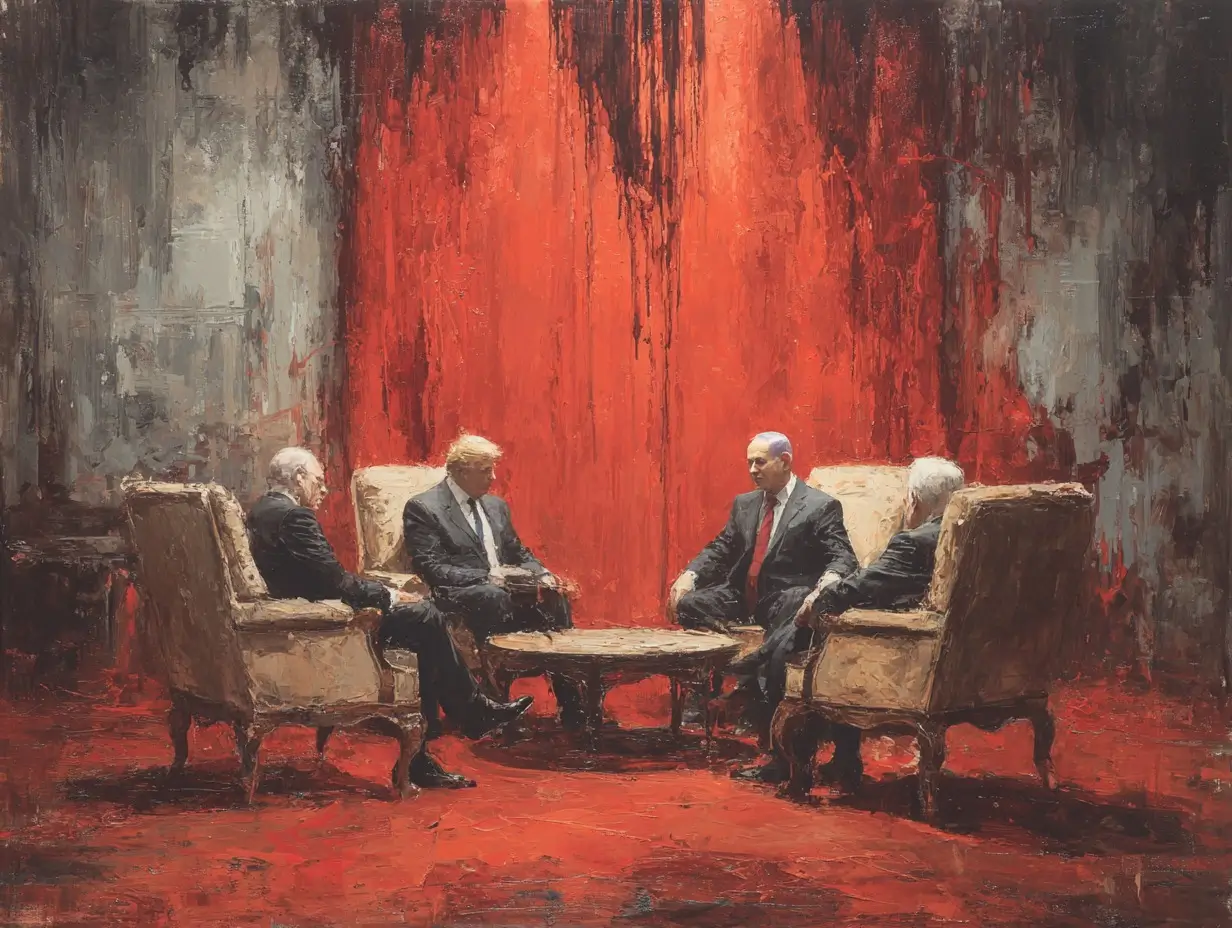
Diplomatically, the structure is sealed by vetoes and silence. The U.S. blocked three ceasefire resolutions in the UN Security Council; Britain abstained, ensuring paralysis. When the International Court of Justice opened genocide proceedings, Western governments undermined the process. Even humanitarian relief became leverage: suspending UNRWA funds at Israel’s request, Western capitals weaponized starvation.
Gaza, then, is not merely a humanitarian crisis. It is a demonstration of how systemic Western unity translates into sustained Muslim vulnerability.
Shielding the Project from Democracy
Perhaps the most striking feature of the Western-Israeli compact is that it survives against the will of Western publics. Poll after poll shows majority support for a ceasefire, yet governments intensify military aid.
In the United States, 68 percent of Democratic voters favoured a ceasefire in late 2023, but Congress voted for billions in new arms. In Britain, 66 percent of the public wanted arms sales halted; export licenses were renewed. Across Europe, protests filled streets, yet trade expanded. The democratic will is irrelevant when it collides with the strategic logic of empire.
This insulation is deliberate. Political lobbies enforce discipline in Washington; accusations of antisemitism silence dissent in Germany; protest restrictions curtail marches in France and the UK; and universities purge students for expressing solidarity. Media ecosystems reproduce Israeli narratives and minimize Palestinian deaths. Humanitarian NGOs lose funding if they challenge Israeli policy.
What emerges is a Western order that suspends its own democratic principles to sustain Israel. The project is therefore not only militarized but non-democratic by design. Shielding Israel from accountability requires shielding it from democracy itself.
A Divided and Complicit Muslim World
Facing this unified Western front is a Muslim world that remains fragmented, dependent, and complicit. More than fifty states exist under the banner of Islam, yet none act collectively. The lines drawn by colonial cartographers still divide the ummah into manageable fragments, each governed by elites whose survival depends on Western favour.
Some regimes normalize relations, granting Israel legitimacy it could never win on its own. Others host U.S. military bases that form the very logistics chain defending Israel’s airspace. Many recycle petrodollars into Western banks and arms industries, effectively financing the machinery that subjugates them.
The silence of Arab rulers during Gaza’s destruction is not mere cowardice; it is structural dependency. For decades, they have oscillated between fiery rhetoric and quiet submission, denouncing Israel in speeches while seeking Washington’s approval behind closed doors. Their legitimacy rests not on the consent of their peoples but on Western protection. Thus, they cannot defy the very powers that guard their thrones.
The tragedy is that Muslim fragmentation sustains Western unity. Every divided capital, Riyadh, Cairo, Ankara, Islamabad, Doha, functions as a separate node of dependency. Without transnational coordination, Muslim wealth, manpower, and geography remain tools in others’ hands.
The Ottoman Lesson
History provides the counter-example. For centuries, the Ottoman Caliphate embodied transnational coherence: a single political roof sheltering diverse peoples, balancing pluralism with power. It deterred foreign encroachment and preserved Muslim sovereignty from the Atlantic to the Indian Ocean. Its dissolution in the early twentieth century opened the way to partition, colonial mandates, and eventually the establishment of Israel.
The Ottoman lesson is not nostalgia but strategic instruction. The Caliphate was the only system that bound the ummah under a single political authority accountable before God and the people. Its collapse removed the defensive shield that had protected Muslim dignity for centuries. Without a central authority representing collective will, the ummah became a mosaic of clients and protectorates.
Reclaiming that unity is therefore not a dream of revivalists; it is a strategic imperative for survival.
Towards a Muslim Counter-Project and political unification
The counter-project is not merely economic coordination or diplomatic reform. It is to break the colonial divisions and re-establish a political unity under the system of the Caliphate, an accountable, just, and representative order that transcends borders and restores sovereignty to the ummah.
Such a system would unify Muslim lands under one leadership chosen through shūrā (consultation), governed by law rather than lineage, and responsible for the welfare of its people. It would replace the autocracies sustained by Western patronage with a polity rooted in justice, consultation, and accountability. It would integrate defence, trade, and education under a single strategic command and end the dependence that keeps fifty states vulnerable to one small fortress.
Economic and military coordination gain meaning only when anchored in this political framework of unity. The Caliphate is not a relic of empire but a system of governance proven to balance diversity with coherence, power with accountability, faith with pragmatism. It institutionalized the collective will of Muslims and translated moral vision into policy.