


The article argues that the current Gulf crisis represents a historic turning point where Anglo-American maritime supremacy, which has underpinned global order since Britain’s naval dominance began in 1763, is facing its first genuine challenge. For over two centuries, the West has maintained control over critical waterways like the Strait of Hormuz, ensuring the uninterrupted circulation of global trade and energy that formed the foundation of financial systems from the British imperial era through America’s petrodollar order. However, Iran’s asymmetric capabilities are demonstrating that even the world’s most powerful military cannot fully guarantee maritime access through this strategically vital chokepoint, threatening to shatter the perception of permanent Western dominance and potentially collapsing the “just-in-time” global economy into a “financial winter” where energy and food shortages trigger systemic breakdown across interconnected markets.
1. The Birth of Anglo Maritime Supremacy
Modern Western dominance did not begin in Washington or Wall Street. It began at sea, in the brutal struggle for control over oceans, trade routes, and
strategic chokepoints that would ultimately shape the architecture of the modern world. The foundations of today’s global order were laid after the Seven Years’ War in 1763, when Britain emerged not merely as a victorious kingdom, but as the dominant naval and commercial power on earth. British strategists increasingly understood a geopolitical truth that would define the next two centuries of history: whoever controlled the seas controlled commerce, and whoever controlled commerce controlled wealth, industry, and ultimately power itself.
That supremacy became irreversible after the Battle of Trafalgar in 1805, when Admiral Nelson destroyed the combined French and Spanish fleets and secured Britain’s command of the oceans during the very moment the Industrial Revolution was transforming the global economy. The Royal Navy did not simply defend Britain’s shores; it protected the circulation of empire itself. Grain, tea, cotton, coal, gold, and eventually oil moved through maritime arteries secured by British naval dominance, while London evolved into the center of banking, shipping insurance, commodity trading, and global finance because Britain controlled the movement upon which world commerce increasingly depended.
The empire’s true currency was never merely sterling. It was maritime certainty — the belief that British naval supremacy would permanently keep the arteries of global trade open. For more than a century, merchants, financiers, and governments built entire systems around that assumption. Britain did not merely conquer territory. It conquered circulation itself.
2. America Inherits the Empire and Builds the Petrodollar Order
The twentieth century transferred this maritime empire from London to Washington, but the transfer changed far less than many imagined. Two World Wars exhausted Britain financially while elevating the United States into the dominant industrial, military, and financial power on earth. Bretton Woods formalized the transition, replacing sterling with the dollar as the backbone of the international financial system, yet beneath the changing flags the underlying logic of empire remained identical.
Financial dominance still depended upon maritime dominance.
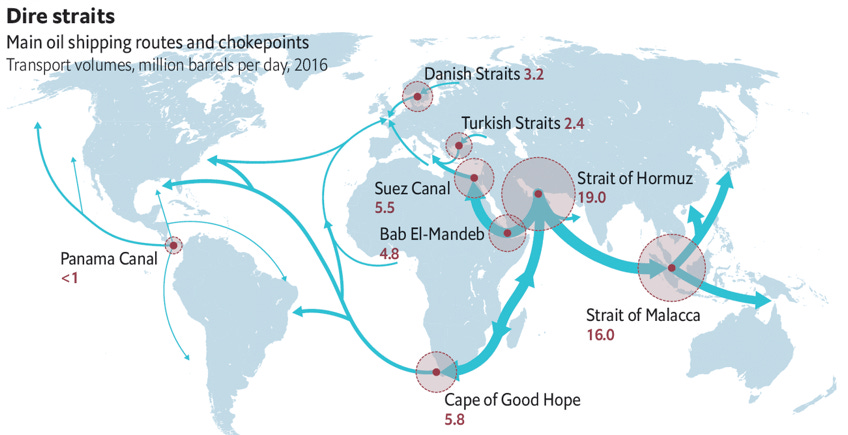
The United States Navy inherited Britain’s historic role as guarantor of the oceans and strategic trade corridors through which the lifeblood of the global economy flowed. American naval supremacy protected the sea lanes connecting the Mediterranean, the Persian Gulf, the Indian Ocean, and the Pacific, allowing Washington to anchor a global order whose stability rested upon uninterrupted circulation through a handful of critical waterways.
Then came the decisive transformation that would define the modern age. In 1971, President Nixon ended dollar convertibility into gold, forcing Washington to confront a historic challenge: without gold backing the currency, what mechanism could sustain permanent global demand for dollars and preserve American financial supremacy?
Oil became the answer.
Through agreements with Saudi Arabia and Gulf monarchies during the 1970s, global oil sales became overwhelmingly denominated in dollars while the United States provided military protection and strategic guarantees to Gulf producers. This arrangement fused energy dependency, financial dominance, and military power into a single self-reinforcing imperial structure. Every industrial economy on earth now required dollars to purchase energy, while Gulf oil wealth flowed through American-protected sea routes and back into the U.S.-led financial system, allowing Washington to finance extraordinary deficits, military expansion, and global influence on a scale unprecedented in history.
At the center of this system sat one narrow waterway: the Strait of Hormuz, through which roughly one-fifth of global petroleum consumption passes every day. The modern world economy therefore came to rest upon one central assumption above all others, Anglo-American naval supremacy would permanently guarantee circulation through the world’s most critical waterways.